


Many investors understandably still have some PTSD from the rapidly rising bonds yields of 2022 and the historic bond bear market that ensued. We take the view that for long-term investors, rising yields are not something to be concerned over. Here’s why.
First, let’s look at why yields are rising.
The Federal Reserve only recently (and modestly) raised short-term rates for the first time this year. Longer-maturity bond yields, however, have been rising for most of 2026, and for several reasons: war in the Middle East pushing up energy prices, AI spending creating competition for capital, and of course, ongoing concerns over the growing US federal debt.
Among these factors, though, is another, more positive reason for higher rates – the US economy has been resilient. Economic growth can put upward pressure on interest rates as demand for capital increases and investors adjust expectations for future growth and inflation. To say that yields are rising on “bad news” is only part of the story.
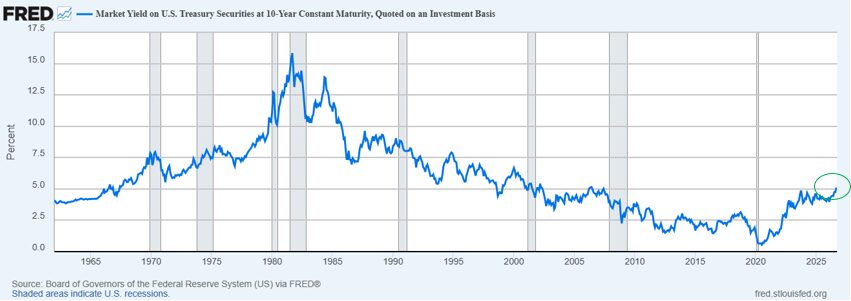
And though elevated compared to recent years, today’s 10-year Treasury yield of just over 5% is still below levels seen throughout much of history, as illustrated in the chart below.
What does it mean for my portfolio?
While a sharp rise in yields can be temporarily painful for investors (remember that when yields rise, existing bond values tend to fall), we view higher bond yields as being generally positive for diversified, long-term investors for two reasons.
- One of the main objectives of fixed income is just that – income!
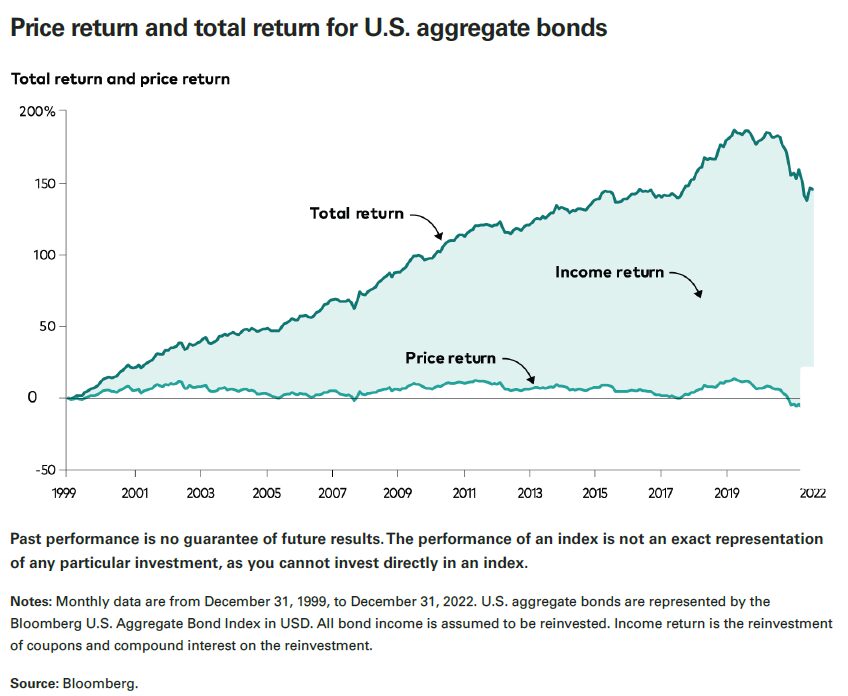
Higher-yielding bonds offer investors more income, contributing to total portfolio returns and helping to offset negative moves in prices. In fact, for long-term investors, most of the return from fixed income tends to come from interest payments compounded over time, not price appreciation. As shown in the chart below, the price of aggregate US bonds actually trended downward over a 20+ year period, but total return, including reinvested income, was positive over that timeframe.
- Bonds are intended to provide portfolio stability, and higher rates can help.
Although still a risk-bearing asset class, high-quality bonds have historically been less volatile than equities1 and therefore intended to mitigate drawdown potential in a stock/bond portfolio when the stock market experiences a decline.
Higher yields provide an additional margin of safety by generating more income to help offset potential drawdowns. Additionally, when yields start at higher levels, bonds generally have greater potential for price appreciation should rates decline.
Popular consensus in the late 2010’s was the notion that, with 10-year Treasury yields below 1%, there was “nowhere for rates to go but up”, which meant the near-term outlook for bonds was not very optimistic. Contrast that with today’s 10-year yield of over 5%, and the outlook is much more positive.
The contribution of income to the total return of bonds is important. Consider the left chart below, which illustrates that, in the roughly 2-year period starting October 2023, the 10-year Treasury yield effectively went nowhere, dipping from around 5% to nearly 3.5% and back up. However, bonds during that time clocked a higher positive return thanks to higher yields as shown in the chart on the right.
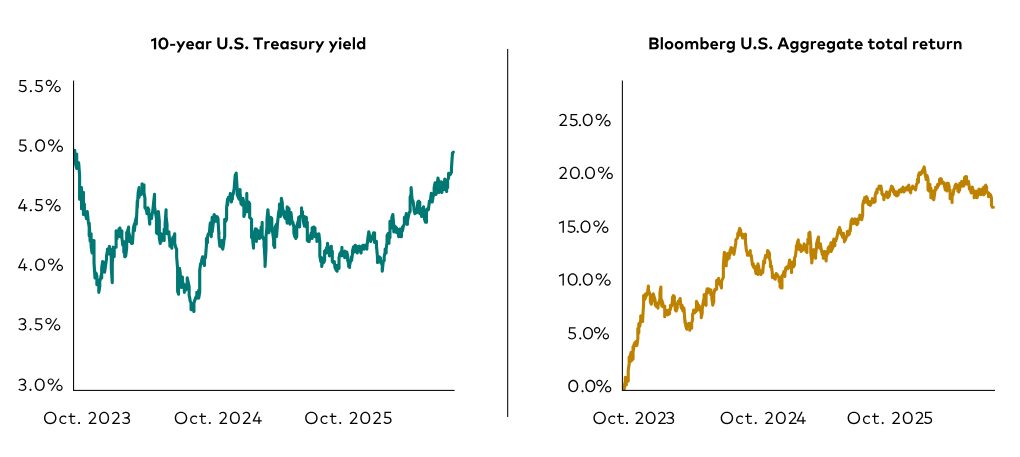
Source: Ycharts, courtesy of Vanguard
What comes next?
Financial headlines are sure to continue zeroing in on short-term volatility. The important thing for long-term investors to remember is that bonds have a purpose in their overall plan – providing income, moderating portfolio volatility, and providing diversification alongside other asset classes.
Rising yields may create short-term price fluctuations, but they also improve the income and diversification benefits bonds can provide within a portfolio.
If you have questions about how bonds play a role in your own investment strategy, please feel free to reach out to your Wealth Advisor to discuss further.
-
1 Source: https://investor.vanguard.com/investor-resources-education/understanding-investment-types/what-is-a-bond