


Market declines are uncomfortable. Understanding whether your financial plan can withstand them can provide much-needed perspective.
A client emailed saying “My account has gone down $X in a short amount of time. With my impending retirement, should I make a change or be worried?”
It has been a nasty little week in the markets, with all major U.S. stock indexes dropping 7 to 8%1 through this writing.
While drawdowns of these magnitudes can be concerning, they are not unusual. In March 2026, the S&P 500 experienced a similar decline amid geopolitical conflict, sharply higher oil prices and renewed concerns about inflation and interest rates.
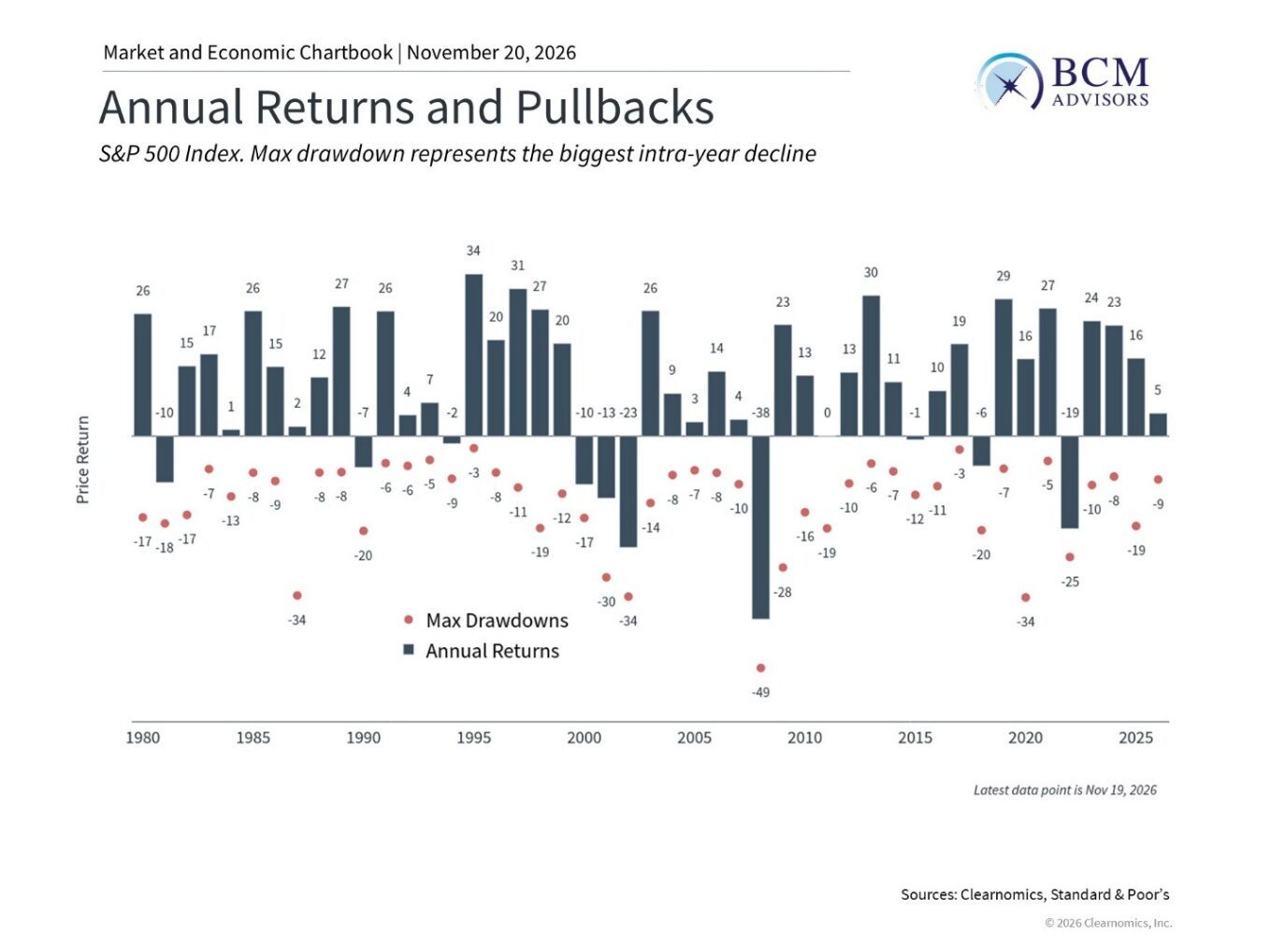
More broadly, the stock market has experienced a mid-year average drop of -13.5% each and every year since 19802, with most years ending in positive territory. The chart below helps to put that volatility in perspective.
Additionally, incorporating other assets such as bonds, cash and gold may help reduce overall portfolio volatility compared with owning stocks alone.
Is there anything I can do?
To help put market volatility in perspective, we encourage clients to take the following steps:
- Put the Decline in Historical Perspective: Market declines are uncomfortable, but they aren’t unusual. Revisiting charts like the one above above can be a helpful reminder that periodic declines are part of the cost of participating in the market’s long-term growth potential.
- Evaluate Diversification in your Total Portfolio Strategy: Diversification shouldn’t stop with the accounts managed at BCM. Retirement plans, cash, concentrated stock positions and other financial resources, including Social Security, should be considered together. For perspective and example, $40,000 of annual Social Security income produces the same annual cash flow as a hypothetical $800,000 bond paying a 5% coupon. Evaluating all your financial resources together can help determine whether your overall strategy remains consistent with your goals and desired level of risk.
- Run a Market Stress Test: Just as engineers stress-test bridges, financial plans can be tested against a variety of difficult market environments. This can help illustrate whether your portfolio and financial plan remain positioned to fund your spending needs throughout retirement without being derailed by severe market downturns.
Will the markets continue to slide? Sure, they will. Either now, or later. They always have and they always will. And after the slides, they’ve always recovered.
While this can leave people uncertain about what will happen next, periods of volatility are an opportunity to test whether the plan you already have is doing what it was designed to do. This can help to take a step back from the day-to-day fluctuations and put this and future market declines in better perspective.
If you would like to evaluate your total portfolio strategy or would like to learn how to run a stress test on your portfolio, give your advisor a call.
1 Tradingview.com – DIA, SPY, QQQM
2 Clearnomics