


The US economy started 2026 on a relatively strong footing, despite AI productivity and labor market fears, uncertainty over FED policy and independence, and geopolitical tensions abounding. Though the markets have reacted only mildly to the developments in Iran (US stocks in a ~ 7% drawdown at the time of this writingⁱ), financial headlines have shifted their attention from energy prices and inflation to full-blown recession predictions.
We’re not sounding the alarm. Here are three reasons we believe long-term investors should not let recent news cycles disrupt their investment strategies, or even their weekend plans.
- Markets eventually move past recessions
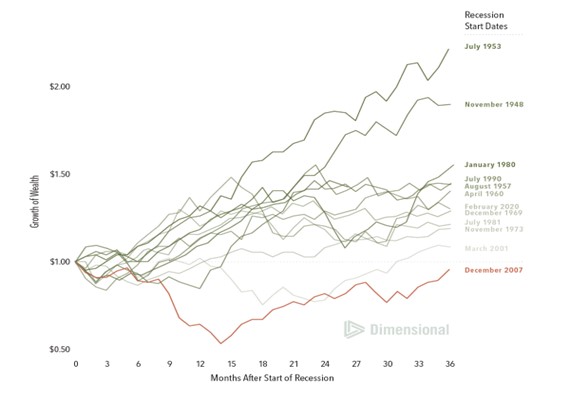
Recessions are a normal part of the economic and business cycle, occurring every 6 years on averageⁱⁱ. As evidenced by the chart below, in many cases the US stock market has been higher even just a few months after the start of a recession, with a few notable exceptions.
Growth of a Dollar for US Stocks over a 3-Year Period Beginning from the First Month of Recessionⁱⁱⁱ
January 1947–March 2025
- Markets are forward-looking
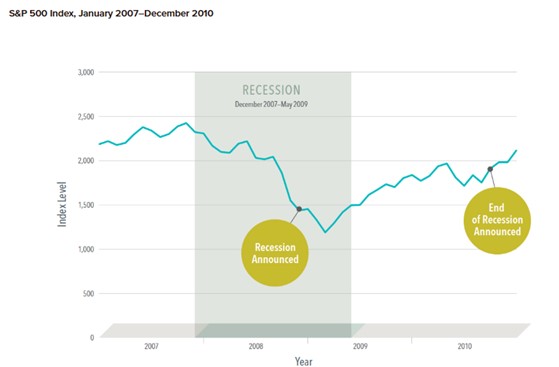
Stock market prices reflect investors’ expectations about future economic conditions, company earnings growth, and all kinds of other factors. Investing doesn’t happen in the rear-view mirror. The chart below shows that in the Great Financial Crisis, the stock market started pricing in a recession around the time it began, but long before it was officially announced, and started its recovery before the end of the recession was declared.ⁱᵛ
- Markets are efficient – maybe more than ever
With millions of market participants casting their vote on the outlook of markets and the economy every day with the dollars they are willing to invest (or keep invested), markets are highly efficient at pricing in all available data. Add to that the relatively new concept of prediction markets, and we may be at an all-time high of market efficiency.
For those unfamiliar, prediction markets such as Kalshi and Polymarket are essentially online casinos where people can bet real money predicting nearly anything under the sun – election outcomes, Grammy winners, and yes, even economic recessions. Popular prediction markets showed odds of a US recession rising from around 20% in January to as high as 35% following strikes on Iran.ᵛ
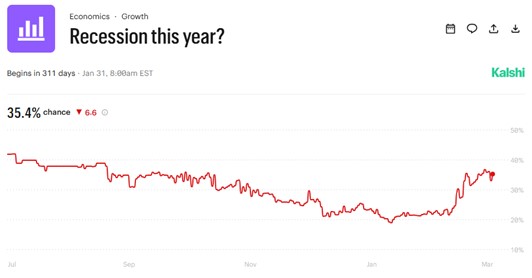
Whether the odds will continue to rise or prove to be correct remains to be seen, but what’s clear is that the implications of a recession are no secret. And the old adage endures – if it’s in the news, it’s in the price. Recession fears may be overblown – only time will tell – but markets are pricing in that potential reality as we speak.
At BCM, we continue to emphasize preparedness, not prediction. If you have questions about how your portfolio is positioned, please reach out to your advisor.
ⁱ https://www.morningstar.com/etfs/arcx/vti/chart
ⁱⁱ https://www.kiplinger.com/slideshow/investing/t038-s001-recessions-10-facts-you-must-know/index.html
ⁱⁱⁱ Chart Source: https://www.dimensional.com/ca-en/insights/recession-and-markets
ⁱᵛ Chart Source: https://www.newcapitalmgmt.com/news/markets-dont-wait-for-official-announcements
ᵛ Chart Source: https://kalshi.com/markets/kxrecssnber/recession/kxrecssnber-26