


Broadening Diversification in a Global Market
For many years, one of the key tenets of BCM’s investment philosophy was an emphasis on U.S. equities, reflecting the belief that many of the world’s best and strongest companies are based in the United States.
While that approach has generally served clients well and we continue to believe that U.S. equities should remain a foundational component in a portfolio’s equity allocation, we also recognize that meaningful investment opportunities exist beyond the U.S. market.
Our analysis has led us to conclude that a measured allocation to international equities can provide meaningful access to a broader universe of companies, countries, currencies, and economic environments.
This change reflects a continuation of our diversification efforts, not a prediction of near-term performance. It does not reflect a change in our confidence in U.S. markets, but rather an evolution of our diversification philosophy.
A World of Diversification
Many investors naturally favor companies and markets they know best. Given the size and success of U.S. businesses, it is understandable that U.S. investors often concentrate their equity exposure domestically. However, despite the strength of U.S. markets, a substantial portion of the global investment opportunity exists outside the United States.
Opportunities Beyond the U.S. Market
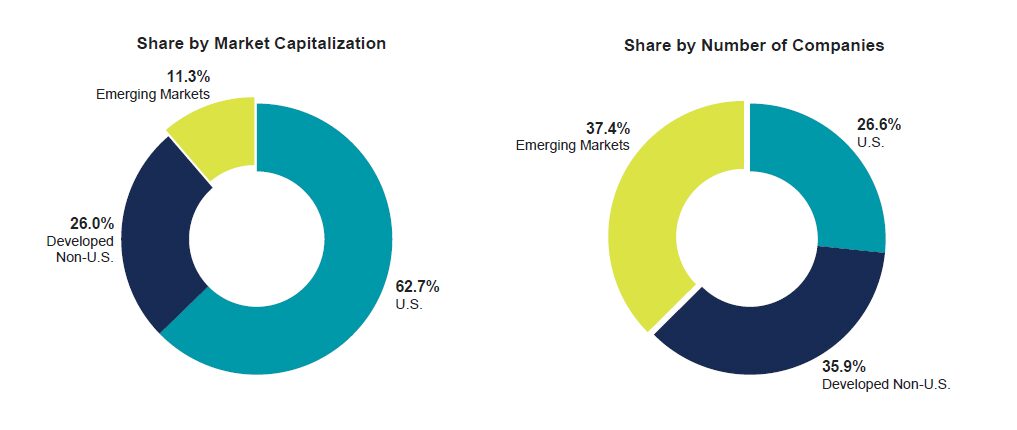
Data as of 12/31/2025. Source: Morningstar. Data represented by MSCI IMI Indexes.
U.S. stocks account for just over 60% of the global stock market, but only about a quarter of the total number of publicly traded companies, leaving a substantial portion of the global investment opportunity outside of the United States. Allocating capital across different geographies means exposure to different economic environments and cycles, fluctuating exchange rates, and independent fiscal and monetary policies.
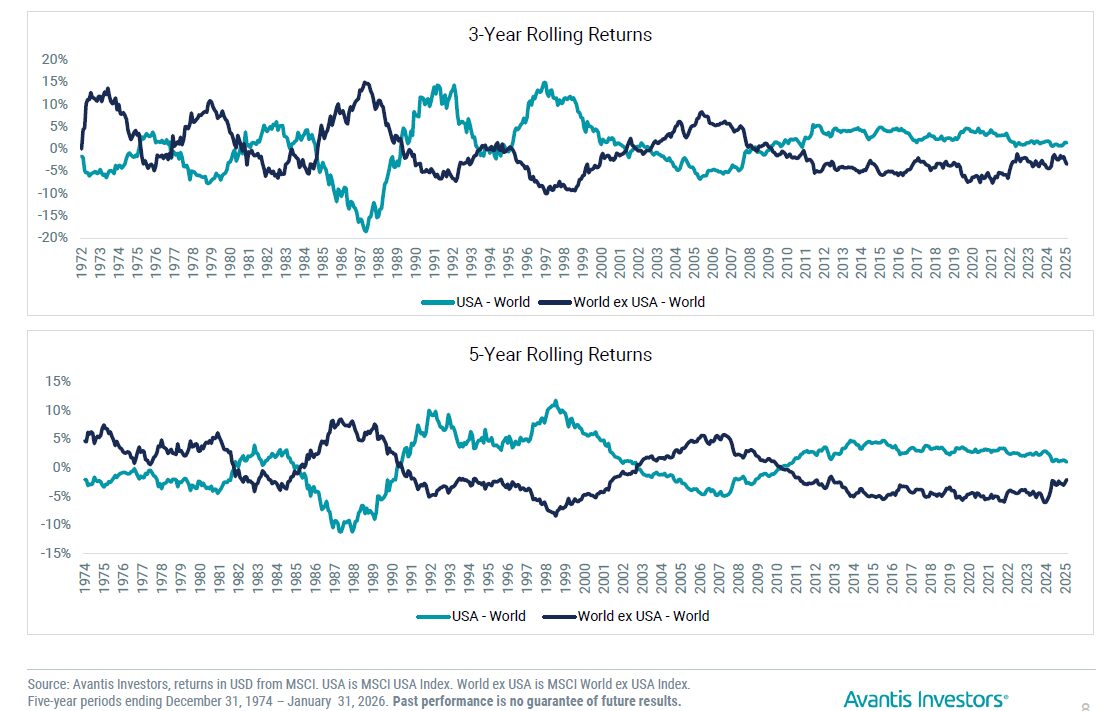
The result? U.S. and non-U.S. equities can exhibit different performance patterns over extended periods. Holding exposure to both can further diversify portfolios within a volatile asset class.
The chart below illustrates how U.S. and international stock markets have rotated in performance leadership over 3- and 5-year periods. Rather than trying to pick winners, holding a meaningful allocation to both U.S. and international markets can reduce reliance on either market remaining the consistent leader.
Why Diversify After Strong U.S. Performance?
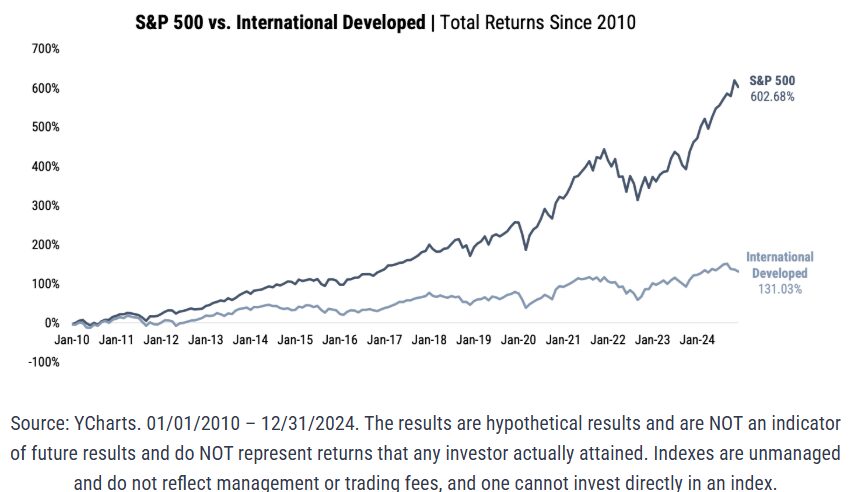
While U.S. stock investors have enjoyed a substantial level of relative outperformance over developed international markets in recent years, there are important underlying factors worth considering:
- Valuation Expansion: One contributor to U.S. outperformance has been valuation expansion – investors have been willing to pay higher prices relative to expected earnings for U.S. companies compared to those in non-U.S. markets.
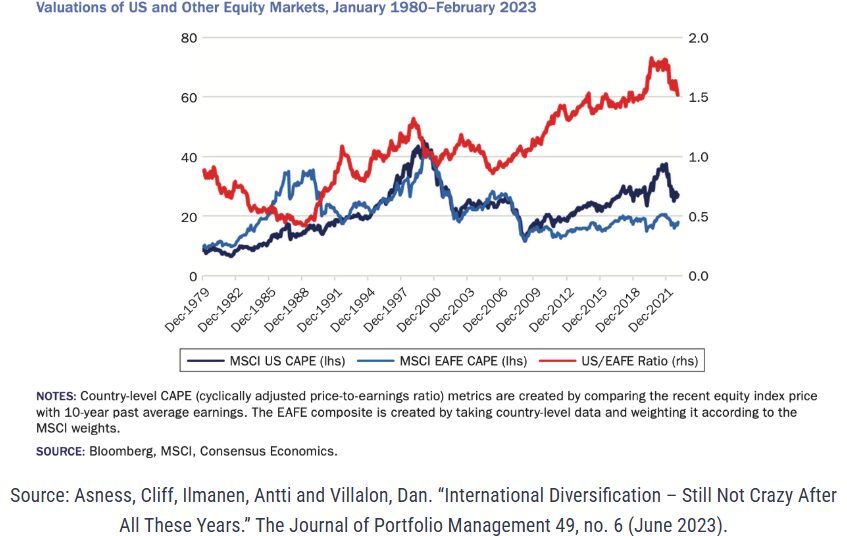
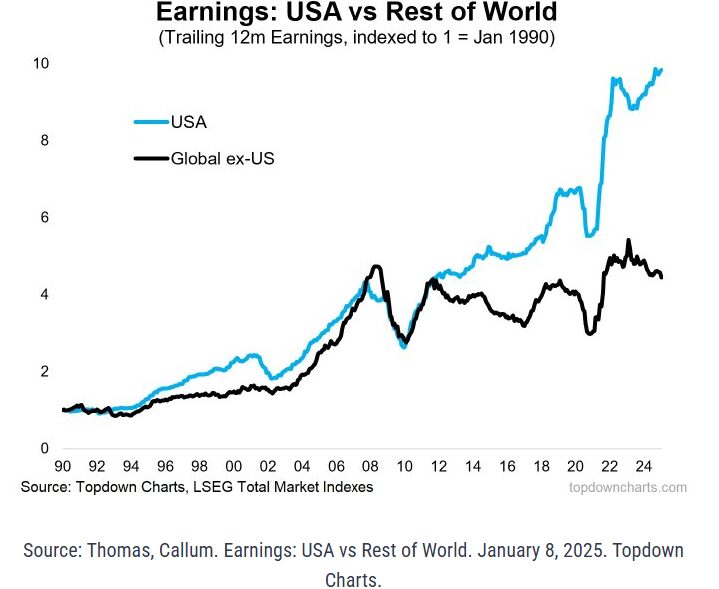
- Earnings Growth: Starting around 2012, earnings for U.S. companies began to materially outpace that of international companies, further compounding U.S. outperformance. This was driven in part by the strong profitability and growth of U.S. technology and communications companies relative to many international peers.
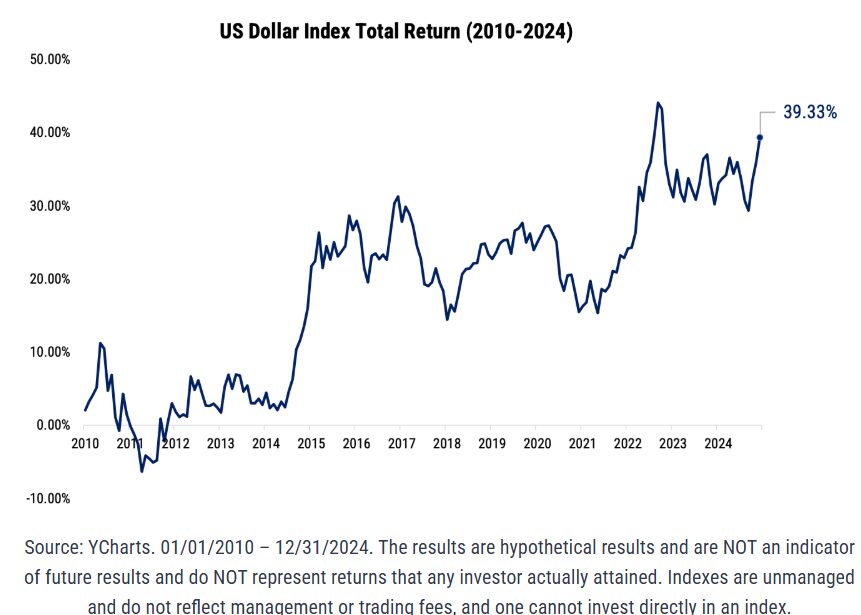
- Exchange Rates: Since foreign equities are priced in foreign currencies, exchange rates also play a role. A weakening U.S. dollar can provide a tailwind for foreign investments, and vice versa. From 2010 to 2024, the U.S. Dollar strengthened relative to many foreign currencies during that period.
Collectively, valuation expansion, earnings growth, and a strengthening U.S. dollar have been important contributors to U.S. market leadership in recent years. Maintaining a predominantly U.S.-based equity allocation allows portfolios to continue participating if these trends persist, while international exposure provides additional diversification should market leadership shift over time.
Diversification over Prediction
The future path of valuations, earnings growth, and currency movements remain uncertain. As long-term investors, we do not believe our clients’ success should depend on accurately forecasting whether U.S. or international equities will lead during future periods.
Instead, we recognize that you don’t have to bet against the U.S. to arrive at the conclusion that an allocation to international markets makes sense for a diversified portfolio.
Accordingly, BCM’s Investment Committee has introduced an allocation to international equities within applicable investment strategies while maintaining a predominantly U.S.-based equity allocation.
Implementation may vary by strategy and account based on tax and client-specific considerations.
If you have any questions or wish to discuss this change further, please contact your Wealth Advisor and we will be happy to have a conversation.